15 November 2026
How to Check Khasra and Khatauni in UP Before Buying Land
Learn how to check khasra and khatauni on UP Bhulekh, review land maps, compare ownership records, and avoid common mistakes before buying land.
By Pushpendra Kumar Saini · Shivaay Properties
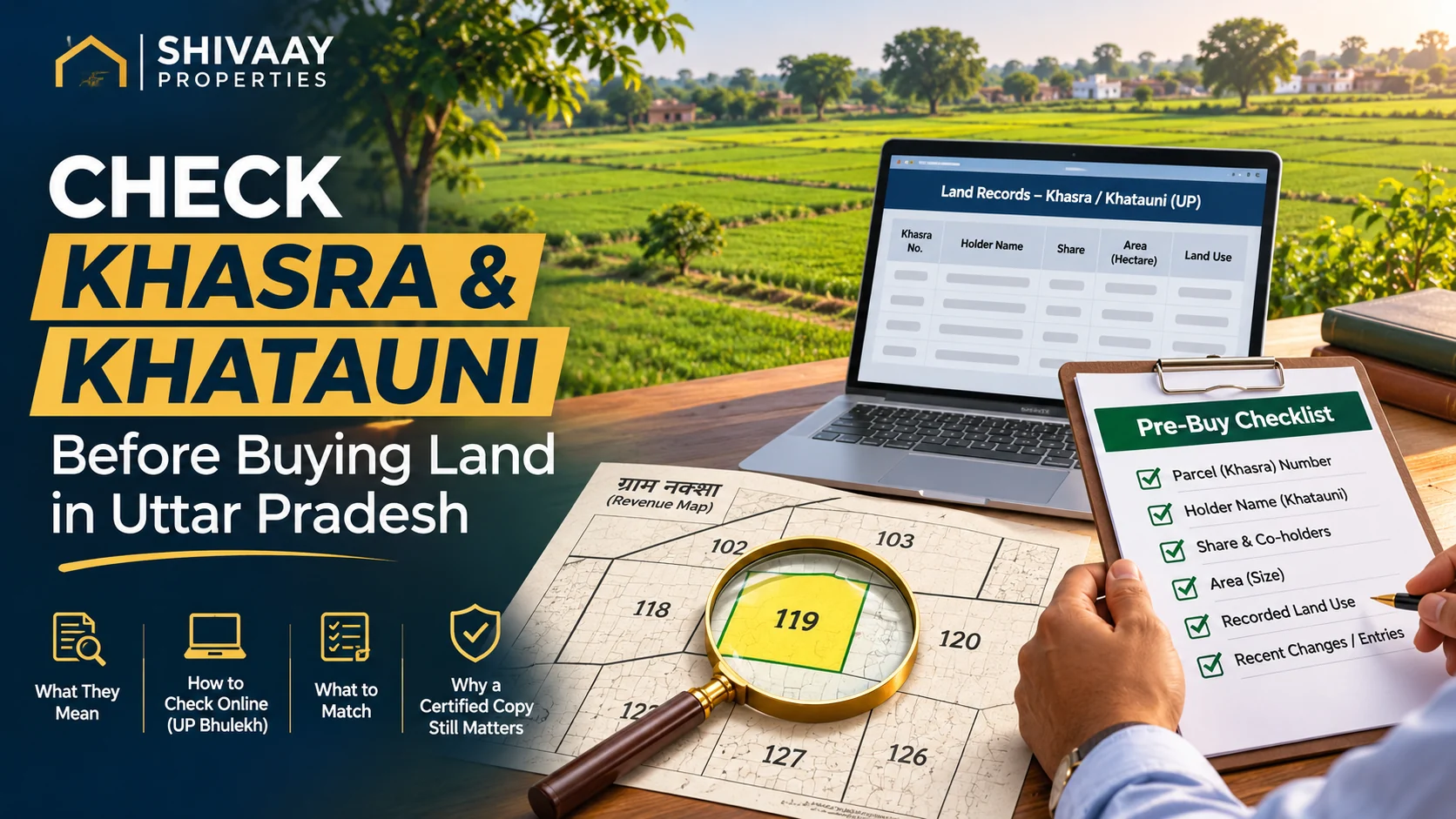
Quick answer: Before paying for land in Uttar Pradesh, collect its district, tehsil, village and khasra/gata number. Search the relevant khatauni entry on the official UP Bhulekh portal, compare the recorded holder, parcel number, area and share with the seller’s documents, and inspect the parcel on UP BhuNaksha. These checks are essential starting points—not proof of clear ownership or permission to build. An independent property lawyer and the relevant revenue/planning offices should check the title and approvals before you commit money.
Buying agricultural land, a residential plot or development land in Uttar Pradesh can involve a large financial commitment. A plot shown on the ground may not match the revenue records; the seller may hold only a share; or the land may not be approved for your intended use. Checking khasra and khatauni records early helps you discover questions before paying token money or bayana.
This English-language guide focuses on UP’s official land-record tools and practical due diligence, with examples relevant to buyers in Saharanpur, Behat, Muzaffarabad and Shakumbhari Road. It provides general information, not legal advice.
Khasra vs Khatauni: What Is the Difference?
| Record | What it generally identifies | What you should verify |
|---|---|---|
| Khasra / gata number | A numbered land parcel and information recorded against that parcel | Does the number, recorded area and land category correspond to the parcel being offered? |
| Khatauni | Revenue record of recorded holders and their land interests, often across one or more parcels | Does the seller’s name appear? What is the share? Are there co-holders or relevant entries? |
| Revenue map / BhuNaksha | The location and boundaries of mapped parcels, subject to the quality/currentness of the mapped record | Does the map correspond with the village, parcel and access shown on site? |
Important: A khatauni entry is a revenue record. It does not independently establish a defect-free legal title. A registered sale deed, prior title documents, inheritance/authority papers and independent searches may also matter. Mutation (dakhil-kharij) changes revenue records; it should not be confused with a conveyance of ownership.
How to Check Khasra and Khatauni Online Using UP Bhulekh
The official UP Bhulekh website is operated under the Uttar Pradesh Board of Revenue. Its interface may change, so use the live portal rather than assuming an older tutorial’s buttons will remain the same.
- Collect the property identifiers. Ask the seller for the district, tehsil, revenue village, khata number if available, and khasra/gata number as written in existing records and sale papers.
- Open the official portal. Visit upbhulekh.gov.in and navigate to the relevant khatauni / land-record view. Avoid unofficial sites that request unnecessary payments or sensitive details merely to show public record information.
- Select the district, tehsil and village. Match the revenue village exactly; a nearby village with a similar name can produce the wrong record.
- Search using the available identifier. Depending on the live screen, search by khasra/gata number, khata number or recorded holder’s name, and complete any displayed verification step.
- Read the full entry. Compare the recorded holder(s), parcel number, area, shares, record year/period and any relevant remarks or changes. Save a dated reference for discussion with your lawyer.
- Resolve any difference before paying. Ask for supporting documents if the seller’s name, share or area does not match; do not assume that a promised future correction is enough.
- Obtain the required official records. For a transaction or any formal use, ask the tehsil or an independent professional what current certified or authenticated copy is required and how to obtain it.
Do not treat a screenshot of the portal as a title certificate. Confirm the underlying record and its currency with the appropriate office, especially where recent transactions, inheritance, corrections or disputes are involved.
How to Check the Land Parcel on UP BhuNaksha
UP BhuNaksha displays a map interface with district, tehsil, village and plot-number selections. It can help you compare a parcel number with the mapped parcel, but an online map alone cannot establish lawful possession, boundaries or road access.
- Choose the same district, tehsil and revenue village that you used for the khatauni.
- Search for the relevant khasra/gata (plot) number using the live map interface.
- Look at neighbouring parcel numbers and any mapped road or access feature; compare them with the seller’s description.
- Visit the site and ask a competent local professional or revenue official about demarcation if there is doubt about boundaries or approach access.
A road that looks usable on the ground is not automatically a legally enforceable right of access. Confirm the position from revenue records, deeds and the competent authority where needed.
Land Verification Checklist: What Must Match?
| Check | Compare against | What to do if it differs |
|---|---|---|
| Revenue village and parcel number | UP Bhulekh, prior deed, seller’s papers, site/map | Pause until the exact parcel is identified |
| Recorded holder and seller identity | Khatauni, ID, registered deed and authority documents | Ask who has the right to sell and obtain legal review |
| Joint holders and fractional shares | Khatauni and title documents | Verify what share is being sold and required parties/consents |
| Area and unit | Khatauni area, deed area, approved survey/demarcation | Resolve discrepancies; do not assume all local bigha measures are identical |
| Recorded land category and use | Revenue entry and applicable planning records | Verify agricultural, residential or other permitted use with the authority |
| Access and boundaries | Revenue map, site and title documents | Confirm legal approach and obtain demarcation if uncertain |
| Changes, inheritance or mutation | Latest entries, previous deeds, succession papers | Review the full title chain and pending changes |
| Charges, disputes and restrictions | Legal searches, documents, registration/revenue offices, other relevant authorities | Obtain independent legal due diligence rather than relying only on khatauni |
Example: Why Joint Ownership Needs Special Attention
Suppose a khatauni lists two recorded holders and the person negotiating with you says they will sell “the entire field.” The khatauni does not, by itself, prove that this person is authorised to transfer the other holder’s interest. Ask your lawyer to confirm the nature of each holder’s right, any partition and who must execute the sale. This is a hypothetical illustration, not a real property.
Example: Why Bigha and Hectare Must Be Reconciled
A seller might quote a price per bigha, while the official land record shows area in a different unit. Local bigha conventions can vary. Ask for a written calculation stating the exact unit basis, official area and price calculation, and reconcile it with the deed and measurement before signing anything. Avoid using one assumed UP-wide bigha conversion.
Red Flags Before Paying Bayana or Token Money
- The seller’s name or selling authority does not match the documents, with no satisfactory supporting explanation.
- Several holders appear in the records but only one person is represented in the proposed sale.
- The plot shown during the visit is not clearly linked to the claimed khasra/gata number.
- Area, boundaries or access claims conflict with the map, survey or prior deed.
- The seller insists that you must pay immediately and check title or approvals later.
- Land is marketed as ready for a colony, farmhouse or commercial project without the relevant use and planning permissions being checked.
These are reasons for further investigation, not automatic proof of fraud. A valid explanation may exist, but it should be verified independently and documented.
What UP Bhulekh Does Not Confirm
Even when the online revenue entry appears consistent, separate investigations may still be necessary for title history, mortgages or other charges, court disputes, government/public land restrictions, physical possession, right of way, acquisition issues, zoning and development permissions. The appropriate inquiry depends on the parcel and transaction.
A lawyer can examine prior deeds, inheritance and authority documents, registered instruments and relevant records. For document-registration matters, start with the official Uttar Pradesh Registration and Stamps portal (IGRSUP) and confirm which search or certified-document service is presently available. Our guide to the encumbrance certificate in Uttar Pradesh explains the registration-record search and its limits. For use and building permission, contact the relevant planning authority rather than inferring consent from the revenue entry.
If you want to construct a home or farmhouse, read our guide to building on agricultural land in Uttar Pradesh. A recorded agricultural classification is not the same as residential or commercial approval.
Seven Steps to Complete Before You Buy Land in UP
- Obtain the exact parcel details and copies of the seller’s supporting documents.
- Review UP Bhulekh for holders, shares, area, remarks and recent changes.
- Compare the parcel on UP BhuNaksha and inspect the land physically.
- Identify possible co-ownership, inheritance, mutation or authority-to-sell questions.
- Obtain the appropriate official records and independent legal title and charge searches.
- Confirm land use, planning permissions, legal access and boundaries for your intended purpose.
- Agree on a written price, payment conditions and contingencies before any bayana. See our guide to bayana versus a registered sale deed.
Frequently Asked Questions
Can I check khatauni online in Uttar Pradesh?
Yes. Start with the official UP Bhulekh portal using the relevant district, tehsil, village and available record identifier. The portal interface may change; cross-check any important record with the appropriate office.
Is khasra the same as khatauni?
No. A khasra/gata number identifies a parcel; a khatauni records landholders and related revenue information. Buyers should compare both and the underlying title documents.
Does a name in khatauni prove legal ownership?
Not by itself. Revenue entries are useful evidence for checking recorded possession/holding but cannot replace verification of deeds, the chain of title and the seller’s power to transfer the property.
Can I buy land if mutation has not been completed?
A pending mutation requires careful examination of the underlying documents and circumstances. Do not conclude that a purchase is safe or unsafe from mutation status alone. Ask an independent local property lawyer to assess the chain of title and explain what must happen before completion.
Can UP BhuNaksha confirm the boundary and legal road access?
It can help identify a mapped parcel, but not conclusively settle a contested boundary or legal access. A site inspection, records and professional demarcation/legal review may be needed.
Is an online khatauni enough before paying bayana?
No. Use the online view as one early check, and complete appropriate document, title, access and permission checks before committing money. The tehsil can advise about available certified records.
Looking for Land in Saharanpur, Behat or Shakumbhari Road?
Shivaay Properties works with buyers exploring agricultural land, plots and development opportunities around Saharanpur, Behat, Muzaffarabad, Chhutmalpur and Shakumbhari Road. We can discuss your location, budget and intended use, share relevant available options and coordinate a site visit. Your own lawyer and the competent authorities must independently confirm title and approvals.
Explore our agricultural land services, find land by purpose, or contact Shivaay Properties. For larger project requirements, see land sourcing for developers.
About the author: Pushpendra Kumar Saini is the founder of Shivaay Properties, a Saharanpur-based property development and consultancy business. Read the founder’s profile.
Disclaimer: This guide is for general buyer education, not legal, tax or surveying advice. Verify current portal procedures, ownership, restrictions and applicable permissions with the appropriate government offices and an independent qualified professional before transacting.